In today’s fast-paced global trade environment, the efficiency of container handling has become a critical factor in the competitiveness of ports. Choosing the right container gantry crane (CGC) is not only vital for smooth terminal operations but also has a direct impact on return on investment (ROI), operational costs, and safety. With multiple types of gantry cranes available, port operators and project developers need to carefully evaluate their options before making a purchase. This article explores the main types of container gantry cranes, their advantages, limitations, and key considerations to help you select the most suitable solution for your port project.
1. Main Types of Container Gantry Cranes
Container gantry cranes are generally divided into two main categories based on mobility: Rail-Mounted Gantry Cranes (RMG) and Rubber-Tyred Gantry Cranes (RTG). Each type has unique characteristics, making them suitable for specific port layouts, cargo volumes, and operational requirements.
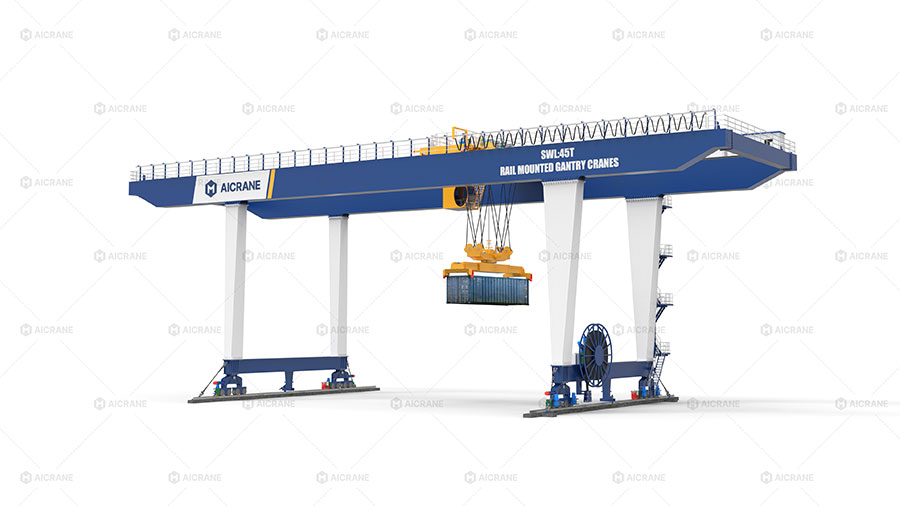
a. Rail-Mounted Gantry Cranes (RMG)
RMG cranes run on fixed rails installed along the container yard, providing a stable and precise lifting solution. They are typically used in high-density container storage areas, especially in large port terminals with high throughput. Key features include:
-
High Lifting Capacity: Most RMG cranes can lift 20 to 100 tons or more, capable of handling 20-, 40-, or even 45-foot containers.
-
Precise Container Handling: The rail-guided movement ensures minimal sway and high accuracy in stacking and retrieval.
-
Durability and Low Maintenance: Rails provide stable support, reducing mechanical stress on the crane’s structure and wheels.
-
Automation-Friendly: RMG cranes are often integrated into semi-automatic or fully automated container handling systems, increasing operational efficiency.
Ideal Applications:
RMG cranes are best suited for ports with large container yards, high stacking requirements, and consistent cargo flow. They are widely used in inland terminals, intermodal yards, and container depots.
Considerations:
-
Initial infrastructure investment is high due to rail installation.
-
Limited flexibility; layout changes require reconfiguring rails.
-
Not suitable for terminals with uneven ground or frequent yard layout modifications.
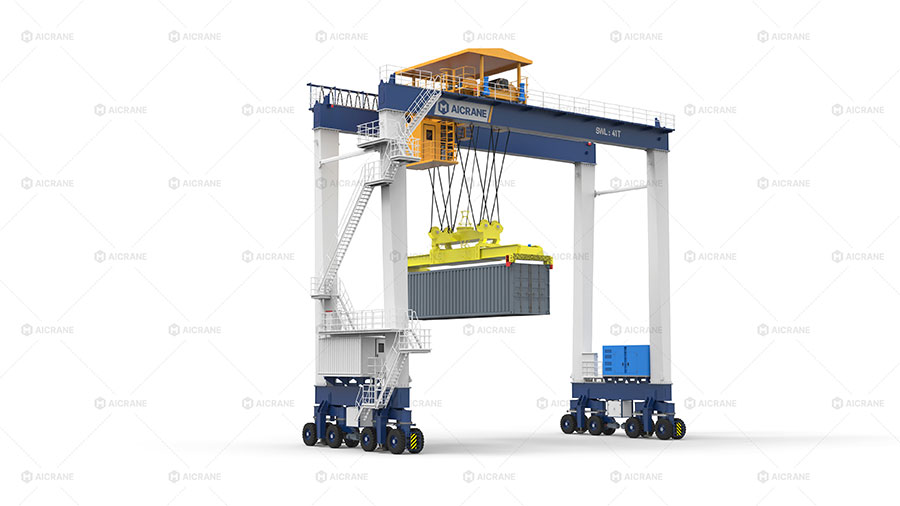
b. Rubber-Tyred Gantry Cranes (RTG)
RTG cranes operate on rubber tires and do not require fixed rails, allowing greater flexibility in container yard management. These cranes are particularly popular in terminals where space optimization and mobility are crucial. Key features include:
-
Flexibility: RTG cranes can easily move within the yard, covering multiple rows without major infrastructure changes.
-
Quick Deployment: Since they do not require rails, installation and relocation are faster and less expensive.
-
Wide Range of Capacities: RTG cranes are available in lifting capacities ranging from 30 to 100 tons or more, accommodating various container sizes.
-
Automation Options: Advanced RTGs offer semi-automated or fully automated operation, including remote control cabins and anti-sway systems.
Ideal Applications:
RTG cranes are suitable for ports with flexible yard layouts, frequent container rearrangements, or smaller terminals with uneven terrain. They are also favored in terminals aiming for phased expansion without extensive civil works.
Considerations:
-
Tires require regular maintenance, and RTGs are more sensitive to ground conditions.
-
Mobility can cause minor alignment issues compared to rail-guided cranes.
-
Energy consumption may be higher than RMGs, especially for diesel-powered models.
2. Key Factors to Consider When Choosing a Container Gantry Crane
Selecting the right container port gantry crane involves more than comparing RTG and RMG types. Several technical and economic factors should guide your decision.
a. Throughput and Capacity Requirements
Assess the port’s expected container throughput. High-volume terminals often benefit from RMG cranes due to their stability and stacking precision, while medium-to-low throughput yards may prefer RTG cranes for flexibility.
b. Yard Layout and Space Constraints
Consider the available space for container stacking and movement:
-
Dense, fixed layouts: RMG cranes optimize stacking height and lane utilization.
-
Variable layouts or phased expansion: RTG cranes allow reconfiguration and relocation without costly infrastructure changes.
c. Lifting Height and Span
Crane specifications such as span (distance between legs) and lifting height are critical:
-
Higher stacks require cranes with taller lifting heights.
-
Wider spans allow covering multiple container rows, reducing the number of cranes needed.
-
Both RMG and RTG cranes can be customized, but RMG cranes offer more precision for very high stacks.
d. Power and Drive Options
Modern cranes are available with electric, hybrid, or diesel-electric drives:
-
Electric drives: Lower operating cost, environmentally friendly, suitable for automated operations.
-
Diesel-electric drives: Provide mobility without needing electrical infrastructure but have higher fuel costs and emissions.
-
Hybrid options: Combine flexibility with efficiency, increasingly popular in modern terminals.
e. Automation and Control Systems
Automation enhances safety, speed, and accuracy:
-
Semi-Automated Cranes: Allow remote control operations, reducing labor costs while maintaining human oversight.
-
Fully Automated Cranes: Integrate with terminal operating systems (TOS) for autonomous stacking and retrieval, ideal for high-throughput ports.
-
Anti-Sway Technology: Reduces container movement during lifting, improving safety and efficiency.
f. Total Cost of Ownership (TCO)
Beyond initial purchase price, evaluate maintenance, energy consumption, and operational costs over the crane’s lifecycle. RTG cranes may have higher tire and fuel maintenance costs, while RMG cranes require upfront rail investment but lower long-term wear and energy costs.
3. Making the Right Choice for Your Port
Choosing the best port container gantry crane depends on balancing performance, flexibility, and cost:
-
RMG cranes are ideal for:
-
Large, high-throughput ports with fixed container yards.
-
Terminals prioritizing precision stacking and integration with automation systems.
-
Projects aiming for long-term stability and efficiency with minimal layout changes.
-
-
RTG cranes are ideal for:
-
Medium or small terminals requiring flexibility and quick deployment.
-
Ports planning phased expansion or temporary container yards.
-
Terminals where investment in rail infrastructure is not feasible.
-
In some cases, ports combine RMG and RTG cranes to optimize performance. For example, RMG cranes handle high-density storage areas, while RTG cranes manage flexible stacking zones near the quay or in temporary storage areas. This hybrid approach balances cost, flexibility, and efficiency.
4. Conclusion
Selecting the right container gantry crane is a critical decision that can significantly impact a port’s operational efficiency, safety, and ROI. While RMG cranes provide stability, precision, and automation compatibility for large-scale operations, RTG cranes offer mobility, flexibility, and faster deployment for dynamic terminal environments. By carefully evaluating throughput, yard layout, lifting requirements, power options, and total cost of ownership, port operators can choose the crane type that best meets their specific project needs.
Ultimately, the decision should align with your port’s long-term strategy, growth projections, and operational goals. Collaborating with experienced suppliers who provide tailored EPC solutions and after-sales support can further ensure your container handling operations run smoothly, safely, and cost-effectively.