As global supply chains place higher demands on throughput speed and operational adaptability, modern logistics hubs, inland container depots, and distribution centers are re-evaluating their material handling options. Managing a mixed flow of heavy cargo – ranging from standard intermodal containers to oversized industrial precast elements – requires yard equipment that balances mobility, spatial efficiency, and infrastructure costs.
Straddle carriers have long played a prominent role in high-volume maritime container terminals. However, their adoption in inland distribution centers, heavy manufacturing logistics hubs, and intermodal freight yards has grown significantly. By straddling the load directly rather than lifting via a cantilevered arm or moving along fixed tracks, straddle carriers present a distinct mechanical approach to heavy yard logistics.
This article provides an objective analysis of straddle carrier technology, examining its operational principles, core advantages, performance comparisons with alternative equipment, and key technical factors for facility managers considering an investment.
1. Operating Principles and Structural Design
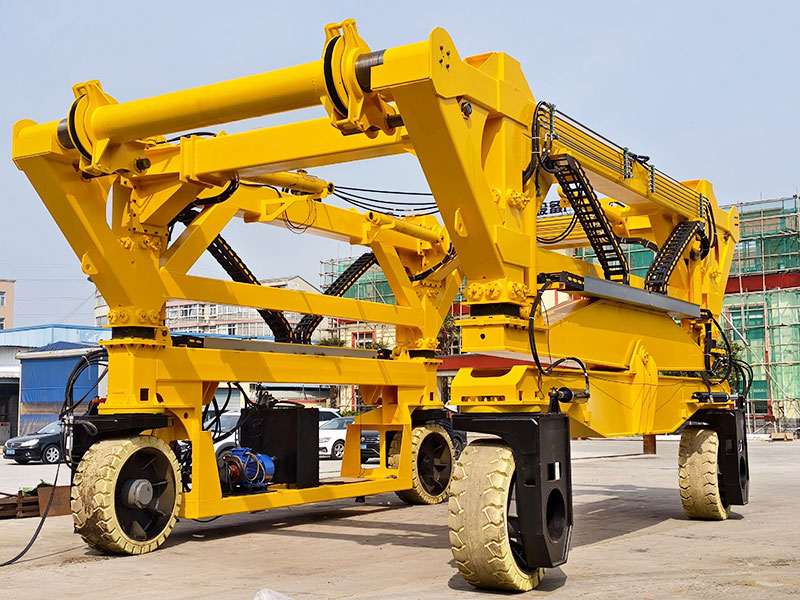
A straddle carrier for sale is a self-propelled, rubber-tyred mobile crane designed to position itself directly over the load it intends to move. Its structural framework typically consists of a high-strength vertical portal frame, an integrated hoisting mechanism (hydraulic or electric winches), a multi-wheel steering system, and an elevated operator cab positioned for unobstructed line-of-sight across the yard.
Unlike reach stackers or heavy-duty forklift trucks—which rely on counterweights and project loads forward on an arm or mast – a straddle carrier encloses the payload within its footprint during transport. The center of gravity remains contained inside the structural frame. As a result, lifting forces are vertically aligned, and the overall load is distributed across multiple axles along both sides of the machine.
2. Key Operational Advantages for Logistics and Distribution Centers
When integrated into distribution center operations, straddle carriers offer several practical advantages rooted in their structural mechanics and wheel configurations.
2.1 Optimized Yard Density and Narrow Travel Aisles
Because a straddle carrier lifts cargo vertically from directly above, it does not require additional clearance in front of or behind the load to maneuver into position. The width of a travel aisle needs only to accommodate the width of the machine itself plus standard safety margins.
In comparison, counterbalanced reach stackers require wide aisles to turn, extend their booms, and stack containers. By adopting straddle carrier solutions, distribution yards can often narrow their travel lanes and reallocate recovered square footage toward additional storage rows.
2.2 Reduced Ground Pressure and Lower Civil Works Costs
Heavy yard machinery places severe stress on yard surfaces. Reach stackers, when carrying a loaded 40-foot container, transfer a concentrated wheel load onto their front axle, which can exceed asphalt capacity and lead to surface rutting or costly reinforced concrete paving requirements.
Straddle carriers mitigate this challenge by spreading both deadweight and payload across 4, 6, or 8 large industrial tires. The lower axle and wheel loads reduce concentrated ground pressure. Consequently, distribution centers can often operate straddle carriers on standard heavy-duty asphalt or existing compacted surfaces without committing to major foundation overlays or rail installations.
2.3 Cross-Zone Mobility and Indoor-Outdoor Transitions
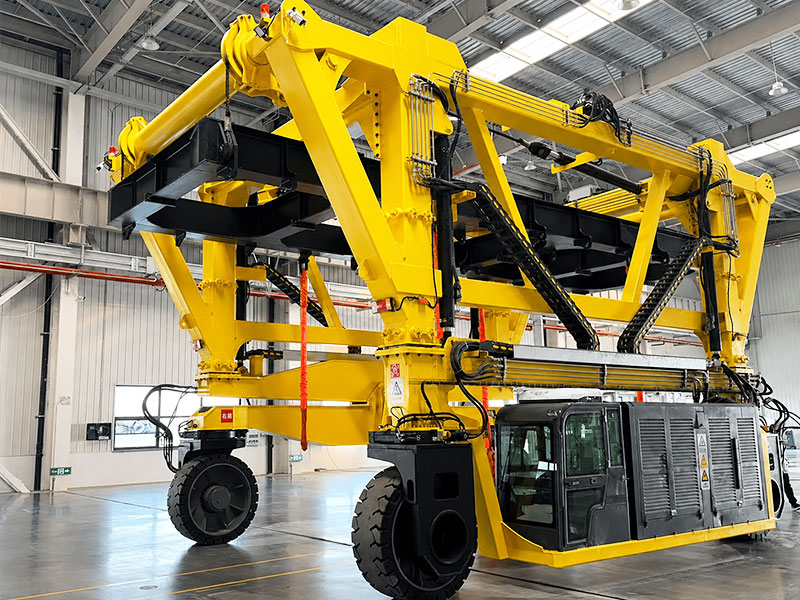
Unlike RMG rail mounted gantry cranes, which are confined to a fixed linear track, straddle carriers are mobile rubber-tyred vehicles. Equipped with multi-wheel steering—including all-wheel steer, crab steer, and zero-turn radius capabilities—they can navigate tight corners and transition seamlessly across different zones of a facility.
This mobility enables a straddle carrier to pick up cargo in an outdoor storage yard and drive directly into an indoor manufacturing bay, warehouse building, or staging canopy (provided door clearances are adequate). Eliminating the need to transfer loads between different pieces of equipment at building entrances helps reduce touchpoints and handling cycles.
2.4 Versatility Beyond Standard Containers
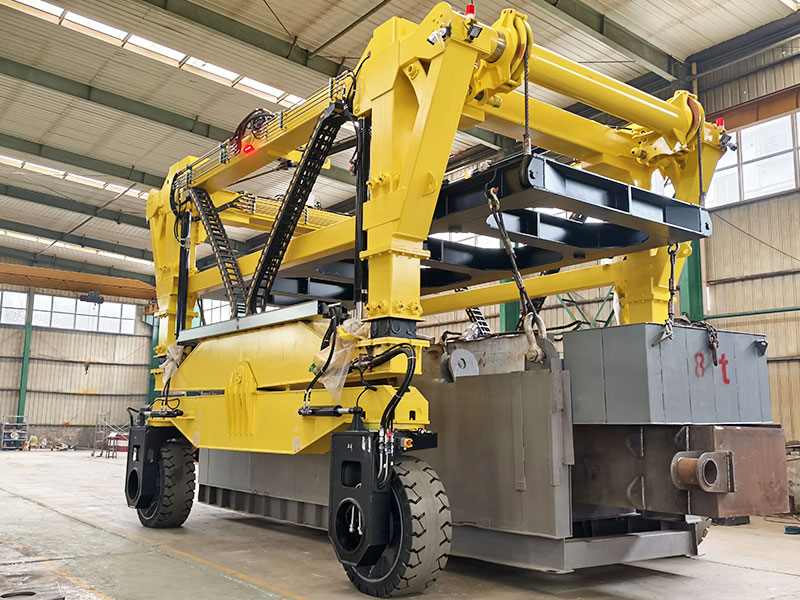
While widely recognized for handling ISO containers using telescopic spreaders, straddle carriers can be configured with specialized lifting attachments. Equipped with lifting beams, hooks, hydraulic clamps, or vacuum grippers, a straddle carrier can handle non-containerized heavy loads, such as:
- Structural steel coils, beams, and plates
- Precast concrete bridge girders and wall panels
- Wind energy components and industrial transformers
- Large machinery assemblies and heavy dies
3. Comparative Evaluation: Straddle Carriers vs. Alternative Equipment
Selecting the appropriate equipment for a logistics yard involves weighing trade-offs among flexibility, spatial constraints, capital expenditure, and stacking requirements.
| Feature / Metric | Straddle Carrier | Reach Stacker | Rail-Mounted Gantry (RMG) |
|---|---|---|---|
| Site Mobility | Fully flexible across paved areas | Fully flexible across paved areas | Restricted to installed rails |
| Aisle Width Requirement | Narrow (slightly wider than frame) | Wide (requires turning radius) | None (operates within span) |
| Wheel Load Distribution | Distributed across 4–8 axles | Highly concentrated on front axle | Concentrated on rail strip foundations |
| Stacking Capacity | Typically 1-over-1 to 1-over-3 | Typically 1-over-3 to 1-over-5 | Up to 1-over-5 or higher |
| Infrastructure Investment | Low to moderate (paved yard) | Low to moderate (paved yard) | High (civil rail foundations) |
| Ideal Operational Focus | Mixed freight, indoor/outdoor transfer | High-stacking container yards | Ultra-high density fixed-path yards |
Straddle Carriers vs. Reach Stackers
Reach stackers excel at stacking containers 4 to 5 high and reaching into second-row stacks. However, they demand wider operating aisles and heavier ground support. Straddle carriers are generally limited to stacking 2 to 4 high, but they operate in tighter aisles and reduce pavement wear.
Straddle Carriers vs. Rail-Mounted Gantry Cranes
RMGs provide maximum storage density and lend themselves well to full automation in high-throughput environments. However, their high upfront civil costs and fixed operational footprints limit adaptability. Straddle carriers offer a flexible middle ground, allowing logistics managers to alter yard layouts as business demands evolve over time.
4. Engineering and Operational Considerations Before Procurement
Before deploying rubber tyred cranes into a distribution center or intermodal hub, several technical criteria should be evaluated during the planning phase:
4.1 Dimensional Clearances and Facility Layout
Logistics managers must verify physical dimensions across all planned travel routes. Key dimensions to audit include:
- Overhead Clearances: Gate heights, door openings, overhead piping, power lines, and lighting fixtures along travel paths.
- Aisle Spacing: Clearances between container rows or material stacks to ensure safe passage.
- Surface Gradients: Maximum incline angles on ramps or sloped yard sections, as steep gradients can impact braking and stability.
4.2 Cargo Specifications and Lifting Attachments
Clearly define the weight ranges, dimensions, and physical properties of the loads to be moved. If handling non-containerized cargo, evaluate whether a custom spreader beam, dual-hook configuration, or quick-change attachment system is required.
4.3 Powertrain Selection: Diesel, Hybrid, and Battery Electric
- Diesel-Hydraulic / Diesel-Electric: Traditional option providing continuous high-duty performance with straightforward refueling.
- Hybrid Systems: Combine a smaller diesel engine with energy storage (batteries or ultracapacitors) to capture regenerative braking power, lowering fuel consumption and emissions during frequent start-stop cycles.
- Fully Electric (E-Straddle Carriers): Zero direct emissions and lower operational noise levels. Ideal for facilities facing strict environmental regulations or operating in close proximity to residential areas, provided charging infrastructure is planned.
4.4 Operator Interface and Safety Systems
Modern straddle carriers incorporate safety features to assist operators working at height, including:
- 360-degree camera arrays and blind-spot radar monitoring
- Automatic anti-sway systems for smooth load placement
- Overload protection and automatic tilt/skew correction
- Options for remote control or semi-automated positioning in structured yards
5. Summary
Straddle carriers represent a pragmatic solution for modern distribution centers seeking to balance spatial efficiency, ground infrastructure demands, and equipment mobility. While facilities requiring ultra-high container stacking may still lean toward reach stackers or gantry cranes, straddle carriers offer a versatile platform capable of navigating narrow aisles, transitioning between indoor and outdoor spaces, and handling both standard containers and heavy industrial goods. Evaluating ground conditions, throughput expectations, and long-term facility plans will help determine whether a straddle carrier solution aligns with your site’s operational goals.